Minorities In Harvest: The Invisible Backbone of Pakistan’s Agrarian Economy

Haseeb Ahmed Khan
Minorities In Harvest: The Invisible Backbone of Pakistan’s Agrarian Economy
Introduction: Land of the Pure, Hands of the Poor
The "Green Pakistan Initiative"—is a massive state-led project to modernize agriculture in the country. Although it actually exposed the tragedy of minority laborers on the ground who are facing eviction and starvation.
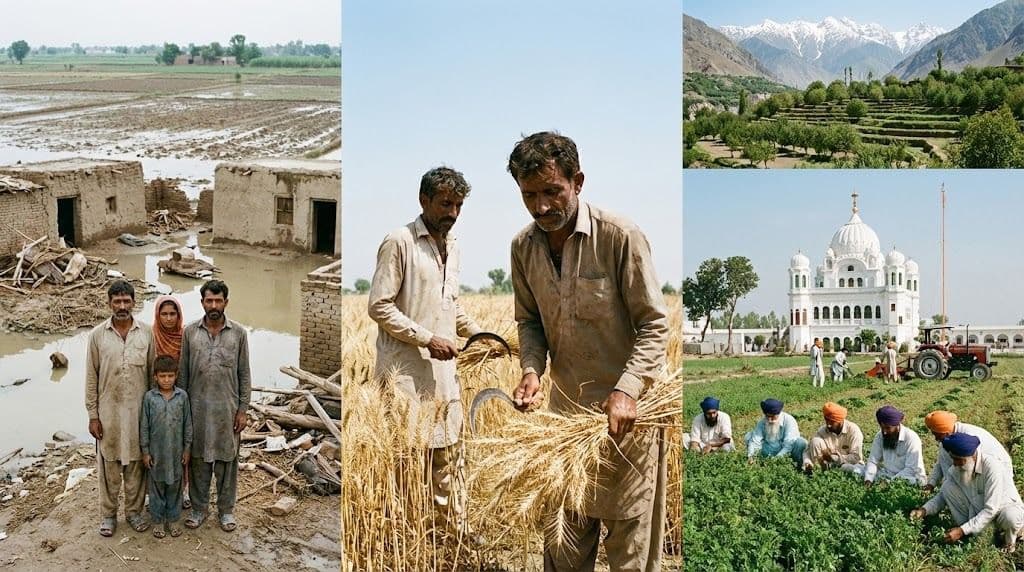
While the state invites global investment for corporate farming, its minority workforce faces a dual crisis: Christians are being physically evicted by land mafias, and Hindu farmers are being pauperized by climate disasters. Only the Sikh community, protected by media-focused religious tourism, is seeing their "Guru’s Land" bloom.
The Displaced Christians (Negative Focus)
- The Green Pakistan Initiative although framed as formalizing this sector is actually doing more harm than good. According to the Transnational Institute report, the military-led corporate farming drive is incentivizing the state to reclaim land from tenant farmers, disproportionately affecting Christian communities who have tilled these lands for generations without title.
- This has been exemplified in the Kot Addu incident where Christian farmers are being pushed out by local ‘land mafias’ while the administration remains a ‘silent spectator’. These forced evictions taking place in Punjab are all over the province and have even been cited by the Human Rights Commission of Pakistan (HRCP) and the Pakistan NGO.
- The recent floods this year, in places like Khushpur are not just destroying crops but washing away the only asset these families have — their mud homes — forcing them into urban slums. Although, increasing floods have been an unfortunate reality for Pakistan rural communities as detailed in the UCA News headline "Pakistan’s Christian farmers keep the faith amid rising waters."
The Destitute Hindus (Negative Focus)
- Pakistan’s tumultuous relationship with wheat has come to head and also sheds light on the depressing situation for wheat debt-trapped farmers as well. Last month only the Chief Minister of Sindh stated that an Rs 87 billion loss was handled to the provincial government due to 9 million bags of wheat rotting in government warehouses. This macro-loss translates to micro-starvation for the Hindu Hari, who had to sell his harvest at a loss, but keeps his debt.
- This failure to protect our minorities economically, lead to devastating legal consequences as when the Hindu family is pauperized by crop failure, they are vulnerable to powerful feudal lords who use “forced conversion” of women as a tool to seize what little land they may have in their name. This has prompted some segments of society to raise voices for the marginalized in their communities as detailed in the article, March against 'landgrab, forced conversion of Hindu women'."
The Protected Sikhs (Positive Focus)
- Pakistan does not have to be this way for minorities. The Daily Times reported "Farming starts on land belonging to Guru Nanak." This 64-acre farming project at Kartarpur Sahib is fueling the Langar (community kitchen) and are managed by the Pakistan Sikh Gurdwara Parbandhak Committee (PSGPC) with full state support. by growing staple crops (wheat/rice) they are able to uphold religious traditions and also provide self-sustainability to a celebrated community.
- Dawn News described "Nankana’s industry, agriculture and Sikh tourism." Signaling that this is a possibility and moreover where there is an influx of pilgrims a ‘dollar economy’ is created that enhances the district's economy. A protected economy with regular tourism allows farming to be a form of diplomacy here and it can be also worked into other areas of Pakistan with sizable minority populations with adequate government and media attention.
Conclusion
Christians fight for possession, Hindus fight for survival, while Sikhs harvest the fruits of diplomacy. State support should also extend to other communities due to the fact that they are the backbone of many specific commodities that are agri-economy depends on.
While the Christians of Punjab and the Hindus of Sindh fight for survival on the feudal plains, a microscopic minority in the frozen peaks of the Hindu Kush faces a different challenge. The Kalash people, guardians of Pakistan’s ancient walnut and mulberry groves, are sitting on a potential goldmine. As we leave the contested wheat fields of the south, we turn our eyes north—to a high-value economy where indigenous tradition meets global export demand: The Pakistan Dry Fruit Market.